Those We Carry
Another loss to grieve
I’m on my way home to Scotland from a visit to Newfoundland to bury my mother’s baby brother – my godfather. The man who read me my bedtime stories as a child and who I expected to still be there to make dark jokes with me to cope when my mother eventually goes. He wasn’t supposed to be the first to go in their generation – in both families, on both sides of the ocean.
For months, I’d been feeling the urge to visit our family in Newfoundland. It felt urgent, but I couldn’t see how we could make the logistics work. No one was in any obviously imminent danger or anything, but nonetheless I felt the urgency.
The day we got the call to say he was dead, the urgency evaporated.
An unexpected rite of passage
The two months between here and there have been surreal, culminating in the absolutely wild experience of being home these last couple of weeks. I know it’s a cliché that everyone says that an unexpected death “really puts things in perspective”, but it’s a cliché for a reason.
The last year has been really hard for me, and I’ve been struggling to get back to feeling like myself. I didn’t expect this trip to be the reset that finally stuck, but it has. I’m going home feeling firmly rooted and centred in my sense of self.
Even on the surface, the trip afforded me respite and time for connection with myself and others in between all the busyness of the purpose of the visit. On a deeper level, it allowed me to revisit and forgive some of the past versions of myself that were still causing me more pain than I’d realised.
The labyrinth metaphor
I’ve been living the expression “you can never go home again” for many years. Rather than being a place where I simply feel at home, St. John’s often feels more like the centre of the Chartres-style labyrinth.
The path of the labyrinth twists and turns, taking you back and forth, and drawing you closer to centre, out to the periphery, and back again several times. This pattern is intended to disorient the rational mind and allows you to revisit points of the circle you’ve already brushed past from a different perspective. By the time you reach the centre, you’ve left behind the mundane and are more receptive to insight and inspiration.
When I stand in the centre of a Chartres-style labyrinth, it always feels comfortingly familiar, but still different from any other time I’ve been there. I don’t always know how long I’ll want to be there, but I know I will always gain some insight. Once I know it’s time to leave the centre, there will be points where the path brings me close again, but it won’t bring me back. Replace “centre” with “St. John’s” and all of that still applies.
The events of this morning told me it was time to leave the centre again.
Strange finality
Through the visitation at the funeral home, the burial, and the memorial his employer put on for him, I have been deeply moved by the ways my uncle touched the lives of others, but my brain has resolutely refused to recognise that he’s really gone.
My family have always been flung to the far reaches of the globe. It’s a fact of our reality that has tended to complicate grief. Is my family member dead or just halfway around the world from here? My heart has no clue half the time.
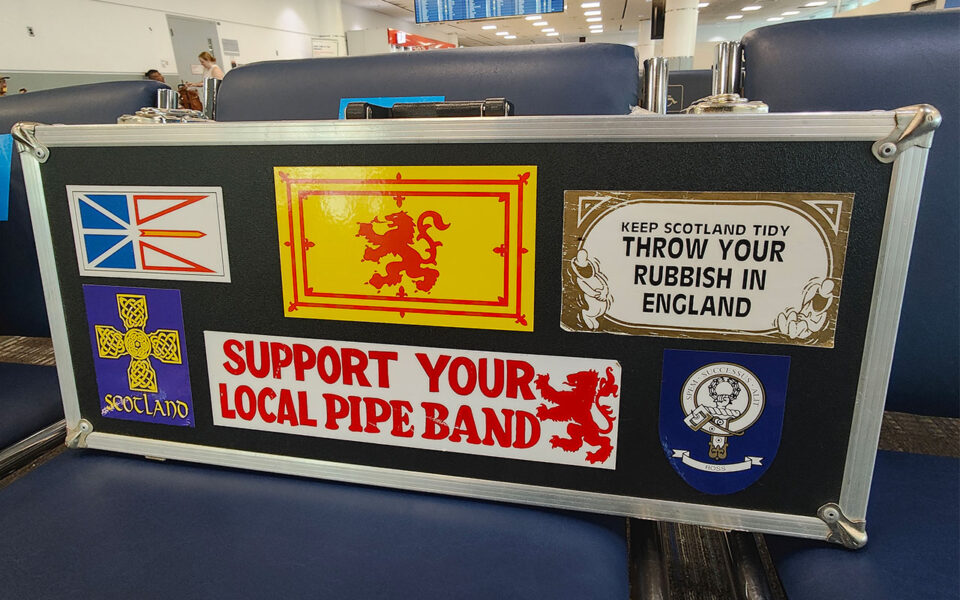
This morning, I carried his bagpipes to the door of his house with the rest of my luggage and it felt like carrying a coffin. I actually did carry his remains during this process and it felt less final than taking those bagpipes out of that house without him.
They didn’t just belong to him, they were part of his identity. A black plastic box could be anything. But the pipes went where he went, and no one was allowed to touch them. Those pipes were never going to leave the house without him until he was gone. So now it’s real.
Carry You
The day before we flew back to Newfoundland, I got to see Tim Minchin perform live, so that was the (entirely appropriate) soundtrack my brain latched onto through the whole trip. For the last week, I’ve been listening to his song, “Carry You”, specifically, on repeat.
Minchin initially wrote this song for his children, and as a parent, it made me openly weep when he performed it live. But as the trip has unfolded, the words have been resonating for me in so many more contexts. As I lifted my uncle’s bagpipes, wearing my grandmother’s engagement ring, which was also given to me during this trip, I deeply felt the weight of the words:
…though we cannot be together
I know that I will carry you wherever I go
I will carry you
Lord knows
I will carry you
A time for reflection
I rarely sleep the night before a flight. I’ve been like it since I was a teenager. The liminal space of travel sets in as soon as I start packing. Last night was no exception. By the first rays of morning, I needed to get out of the house, and apparently Past Elizabeth was kind enough to provide a pretext by forgetting things I couldn’t leave behind with 3 of my friends. (This shit always happens in 3s.)
I started my morning by picking up a beautiful moon goddess art piece gifted to me by a friend who has been like a sister to me long enough for my grandfather to have made time to visit her on the trip he took to say goodbye to lifelong family friends when he found out he was dying 25 years ago.
As we hugged each other tightly, she whispered through tears, “I’m so grateful I was still here to see you.” It was how we started my visit, and now how we ended it.
When my uncle died, my friend was in hospital with life-threatening deterioration of her internal organs – the result of several years of systemic negligence by a patriarchal medical system that dismisses everything a woman says about pain. A week later her father died of comparable problems, albeit more advanced.
I don’t think either of us had really let ourselves understand how close we came to never seeing each other again until we actually clapped eyes on each other. It was sobering. And I never want to go 3 years without one of her hugs ever again.
Peace and closure
Next stop was picking up the amber pendent used in my dedication ritual to Freyja, left with a friend from my undergraduate degree because I had taken it off when the chain was causing a reaction on my skin during our last visit. Of everyone I knew in the Religious Studies department at MUN during the 10 years I took to complete my major, then honours upgrade, then MA, this friend is the one who can probably best understand exactly what I lost when my former academic supervisor and mentor died this spring.
A few other close friends had been around enough to witness what was special to me about my relationship with my supervisor, but this friend had experienced it himself. I was devastated that I couldn’t make it home for that funeral, but somehow I felt better knowing this friend was there to represent us miscreants threatened lovingly with frozen chickens and similar oddities born of the man’s frustration with the inconsistency in the apparitions of our brilliance. (As it turns out, this phenomenon was attributable for both of us to then-undiagnosed ADHD – go figure.) I knew that it was going to be sharing my grief and our reminiscence about that golden era in the Religious Studies department with this friend that would bring about my sense of closure on that loss.
What I hadn’t anticipated was the way my time with this friend on this trip was going to bring healing and contribute to closure for me on other more personal wounds dating back to the timeframe of our shared time in academia. This last brief moment with him for this trip ensured that the warmth of the peace I’ve been able to weave through the enormity of the sense of loss during this rite of passage was at the forefront of my mind as I prepared to conclude my journey.
Children and legacy
The last piece I needed to collect was the hoodie I bought at the Tim Minchin show that ushered in this extended stay in liminal space to begin with. The friend I left that with is my daughter’s godmother. Apart from the depth of our friendship, their bond is special in part because this friend cannot have children of her own.
“Carry You” is about a parent’s bond with his own children. But DNA is not the only way to be a parent. Truthfully, DNA is the smallest part of parenthood. My uncle never had children. Neither of my maternal uncles did. My brother and I benefited from this. They were indispensable strands in the weave of our family of origin. We got bonus father-figures in the absence of our own.
Yet, as important as he was to me, I was still caught off-guard by one of his coworkers telling me that he had talked to her about both me and my daughter. She said he was very proud of us. To what extent, I wonder, would he have related to parental sentiments? We never really talked about it much. He certainly knew I enthusiastically talked about my childhood memories of him. But I can’t recall now if I ever explicitly told him that I counted him as one of my bonus father figures. I know there are many parts of me that are explicitly him – not just the commonality of ancestry. But did I ever tell him that?
Of course, I relate to “Carry You” as a biological mother. Especially one with a painful awareness of my own very human failings. But it is not my biological daughter for whom I openly sobbed at those words during that concert.
And reflected in your eyes
Is all my love and all my lies
Is all my promise and my pride
Is all my fear and all my fight
Is all my dread and my denial
There is a young boy growing up in St. John’s who taught me how to wear the mantle of a mother-figure in the way he chose his relationship with me. The way he left my life was deeply traumatic to me. It is not my story to tell, so I try not to. Still, the image of his clear blue eyes searching mine is seared in my memory. Even though nothing I did could have made a difference to the outcome that took him out of my life, likely forever, I still carry a guilt and worry that I struggle to let go of. I taught him to sing of dragons and I have had to just turn everything else over to my higher powers. Sometimes I pray for him to Sigyn, sometimes to Mary, sometimes to Spirit. Always as a Mother. It is all I can do for him now.
If they would let me trade
I’d give a year for half a day
Just, curled up on the sofa with you
…
I’d hold my breath for, “I forgive you”
…
So though we cannot be together
I know that I will carry you wherever I go
When in doubt, walk a labyrinth
In the initial wake of this child’s absence, I walked the labyrinth every week at the chapel in the mental health hospital. (The location was incidental – it was the only regular public labyrinth walk available in St. John’s at the time.) It was such a vital part of processing those events that I cannot walk a Chartres-style labyrinth without thinking of him. The uncle I just lost actually came with me for one of those walks on that labyrinth. It wasn’t really something that resonated with him, but it meant a lot to me that I got to share it with him at least once.
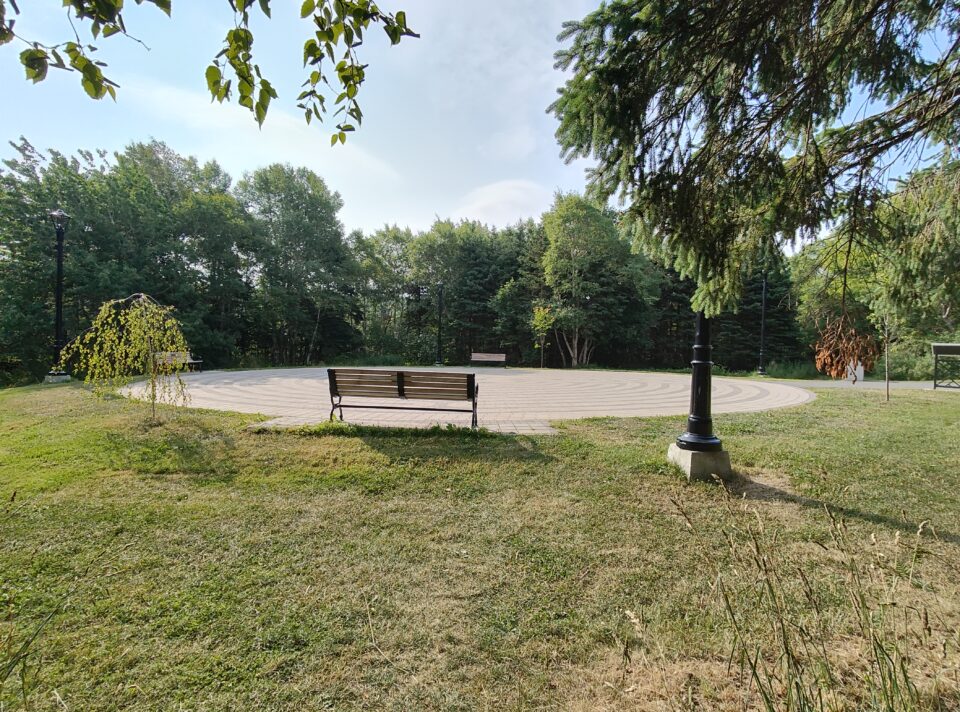
Since then, there’s been a brand-new mental health facility constructed in St. John’s. I gather that the lady who held those public walks persuaded the powers that be to install two labyrinths at the new facility. I’m not familiar with the new facility and I have no idea what is happening with the old building. There is, however, a full Chartres-style labyrinth now installed in the park across the road from the old mental hospital where I used to walk so regularly, so that’s where I went this morning while I waited for my last friend to be ready for my visit.
This park played a central role in my life in St. John’s over the years and it is a place I return to over and over to feel closer to the things that mattered most to me as a child. The fact that a spot I loved to make-believe I was a forest witch has been paved over by a 40-foot labyrinth can be forgiven, since it brings the greatest tool I’ve known for solace as an adult into the heart of the safest place of my childhood memories.
Retracing familiar steps
If you follow the back paths out of the park, you will eventually come to a narrow walkway that comes out at the bottom of the street my grandparents lived on while I was growing up. We lived with them initially when we landed in Newfoundland after my parents’ separation when I was 4. Even when we moved into our own home, we still spent a lot of time at their house. When my grandfather started a 5-year project to build a post-graduate medical training facility in Uganda just a couple of years later, they would come home for summers, and my brother and I would spend as much time as possible at their home.
Every morning at my grandparents’ house, my grandfather was the first to rise. He cherished the solitude of the mornings so deeply that he frequently made breakfast and delivered it to the entire family in bed – my grandmother, mother, two uncles, and my brother – essentially to keep us from disturbing the peace a little longer. Over the years I saw him shoo anyone else who intruded his mornings back to bed. He never shooed me away. It’s probably the only time in my life that I’ve been a morning person. I’d creep downstairs to the kitchen as soon as I heard him in there and I’d help him make pancakes or waffles from scratch and carry the breakfast trays up and down over stairs. By the time the rest of the family were starting to rise and start the day, he and I were ready to slip away for a walk in the park.
The principle of solvitur ambulando (it is solved by walking) was written in my grandfather’s DNA, I’m sure. This is where he taught me to catch butterflies (like he did as a child in Africa), pick raspberries, look for fish in the river, pick the edible mushrooms he surreptitiously propagated in spots dotted around the park and known only to him, and to share companionable silence. Knowing what we know now of neurodivergence, we’d say that he taught me self-regulation. The most important thing he taught me on those walks, though, was that I was loved, exactly as I am, and that I was safe to be me.
His death when I was 16 left a gaping void in the unconditional love category in my life and sent me into a spiral of depression and self-destructive behaviour that has haunted me ever since. Thanks to the eventual outcome of my satiable curiosity about all things spiritual, the depression has been rare for many years, and I have worked hard to minimise the self-destructive. Whenever I felt lost or overwhelmed, though, I often found myself retracing our steps from my childhood. Here in the park, especially in the early morning summer sunlight, I can feel his calm and comfort a little more easily.
On the shoulders of giants
My grandfather was only one of the giants whose shoulders I stand on. My academic supervisor had been the next person I encountered who clearly saw the gifts I carry that are so often obscured by my substantial challenges. My supervisor was also the only person I knew who had ever even heard of The Fourth Way, the system within which I found the spiritual teachers who have had my back while I battled my own demons to learn how to find lasting peace. His knowledge of The Fourth Way afforded me the unique opportunity to both experience and critique the system as the thesis project for my MA.
Fourteen years after I wrote my MA thesis, I would come to different conclusions today about what was happening in the group I studied, but the validation of my insight in the academic analysis ensured that I trusted myself to navigate the extremely challenging situations that arose as the group dissolved with my sovereignty intact. I dodged an awful lot of trauma and trusted my judgement in choosing my last spiritual Teacher, whose guidance supported my journey to completion and independence for years, until he died last September.
Walking with ghosts
My academic supervisor and my spiritual Teacher are just two examples of the kind of giants I’m talking about, among countless others. Both died in the last year. The people who shaped me, taught me, and to whose example I aspire have been dropping like flies lately. And it has been bringing my priorities and assumptions about the world sharply into perspective.
Sometimes I feel you with me in the dark
And your face is in the faces
Of the strangers walking by me in the park
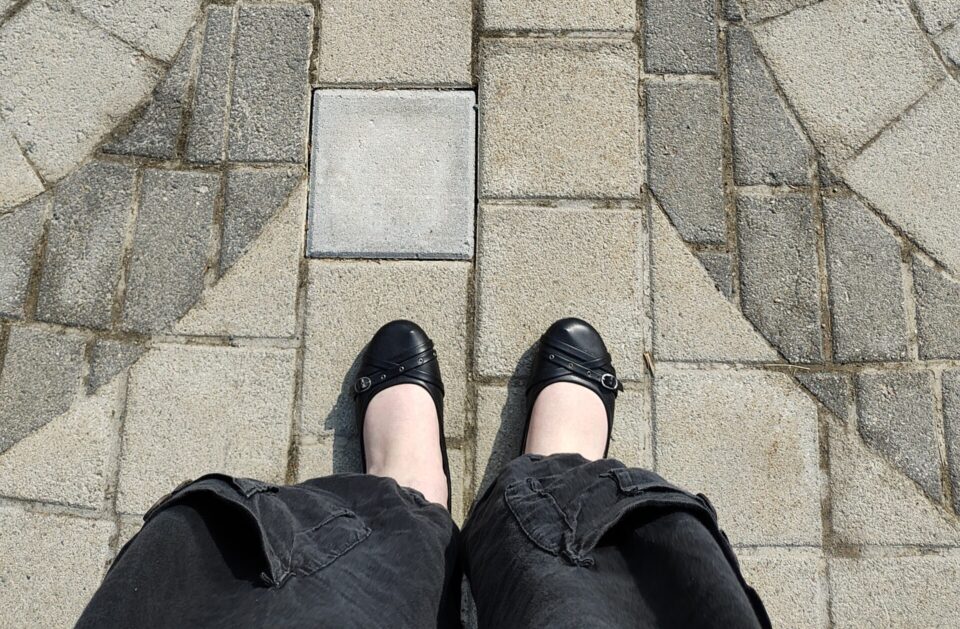
These are the words Tim Minchin sung to me through my earphones as I walked the labyrinth. I happened to glance up at that exact moment and saw a lady walking straight through the labyrinth – it was clearly just part of the walking path to her. For a half a moment I got excited, as I thought I recognised her from my time at the Anglican Cathedral. Just as quickly as the recognition flickered, I remembered reading this woman’s obituary. I blinked away tears and saw clearly that this woman could certainly not have been who I had thought it was.
There were a lot of ghosts on the labyrinth with me this morning. People who have departed this life, people who are far away, people I couldn’t work into my visiting schedule this trip, people with whom there is never enough time, and even many past versions of myself.
A collection of contradictions stitched together with good intentions
Each of the people whose faces and memories came to me on that slow tear-obscured walk in the summer sun are people I carry. Minchin’s inspiration was his children, but the poignant words of his song were crafted into a powerfully universal expression of the internal conflict we often experience whenever we, as deeply, beautifully complicated humans, love other deeply, beautifully complicated humans.
And reflected in your eyes
Is all my love and all my lies
Is all my promise and my pride
Is all my fear and all my fight
Is all my dread and my denial
Humans are not black and white. The qualities that make Tim Minchin so funny, for example, are precisely what make him equally capable of dropping such sincerely moving songs in the midst of the ridiculous. We all exist between some combination of seeming contradictions if you peel back the veneer of what we let most people see.
All aspects of the human experience exist in constant fluctuation. We tend to take for granted anything that fluctuates less, while we treasure most the things that we have once lost. We laugh loudest when we have gone to places so dark that we have been unable to feel anything… and find joy again anyway. We love most deeply when we know what it is like to hurt deeply… and then choose to love again anyway.
Another humourist I love, author Christopher Moore, has written some of my favourite words on the subjects of human nature and grief in his book A Dirty Job:
“Most of us don’t live our lives with one integrated self that meets the world, we’re a whole bunch of selves. When someone dies, they all integrate into the soul – the essence of who we are, beyond the different faces we wear throughout our lives. You’re just hating the selves you’ve always hated and loving the ones you’ve always loved. It’s bound to mess you up.”
(There’s my Fourth Way inclination showing.)
Grief is the price of admission for loving deeply
As I walked the labyrinth this morning, I cried for the absence of those who are no longer physically with me, but I equally cried in gratitude for all the multitudes of loves that showed up for me and my family in the wake of such an incomprehensible loss.
I am a mosaic of pieces I carry from countless others who are all incredible in their own way, most of whom will likely spend their whole lives totally unaware of how deeply they have touched the lives of others. And in turn, I’m sure I haven’t the faintest idea how many other people carry pieces of me in my absence. It has always struck me as slightly tragic that we only give eulogies extolling the virtues of the departed after they are no longer around to hear it.
I carry the pieces of all the people I have ever loved gratefully, and I share them abundantly, so that all those who know me will know them. I aim to love so abundantly that it echoes beyond the confines of the circumstances of my time together with them in this life, because the circumstances of this life are never guaranteed, and love is not finite.
Most of us, at any given time, would give a year for half a day with someone if we could. There was a long time that I let the complicated parts of me get in the way of making the most of the time I do have with the people I feel that way about before it’s no longer possible. I’m still learning how to navigate all of the complicated parts of me, but as I stepped off the labyrinth this morning, I became aware that I was feeling that it is time to leave; I’m returning home to Scotland with refreshed memories of those I carry, and a renewed anchoring to my own self.
With my cup full again, I hope that I can show up better for the people I love, wherever they are. And I hope they never doubt how much I love them.